

Cost to Complete Missing Real Construction Funding Risk

Cost to Complete is the fundamental metric in construction funding risk reporting, but it has one structural limitation—it recognises costs when progress is certified and assumes that payment to subcontractors and suppliers follows.
Of course, it often doesn’t. Although the quantity surveyor assessment sits at the centre of critical funding decisions each month, the reality is that your Cost to Complete forecast is only as reliable as the statutory declarations behind it.
“The QS certifies progress, not payment,” IPEX chief executive Paul Reid told The Urban Developer.
Cost to Complete forecasts ignore unpaid claims
Without alignment between progress claims, drawdowns and subcontractor payments, certified but unpaid work can accumulate without changing the reported Cost to Complete position.
This means that a project may appear on budget even while carrying a significant funding shortfall risk.
For example, $50 million of work may be certified and fully funded but a 10 per cent payment misalignment means an unsecured funding gap of $5 million.
This $5 million is not captured in your forward-looking Cost to Complete forecast but the exposure is real—this cash is now subject to the builders’ broader liquidity position.
Practically, it can’t be assumed that these funds remain available to the project, meaning that any remaining contingency now exists on paper only.
Understanding Cash to Complete
The figure that ultimately matters to developers and lenders is Cash to Complete.
Cash to Complete accounts for:
the forecast cost to finish the remaining scope of work plus
the value of any previously certified but as yet, unpaid claim.
Cost to Complete measures what remains to be built, while Cash to Complete measures what remains to be paid.
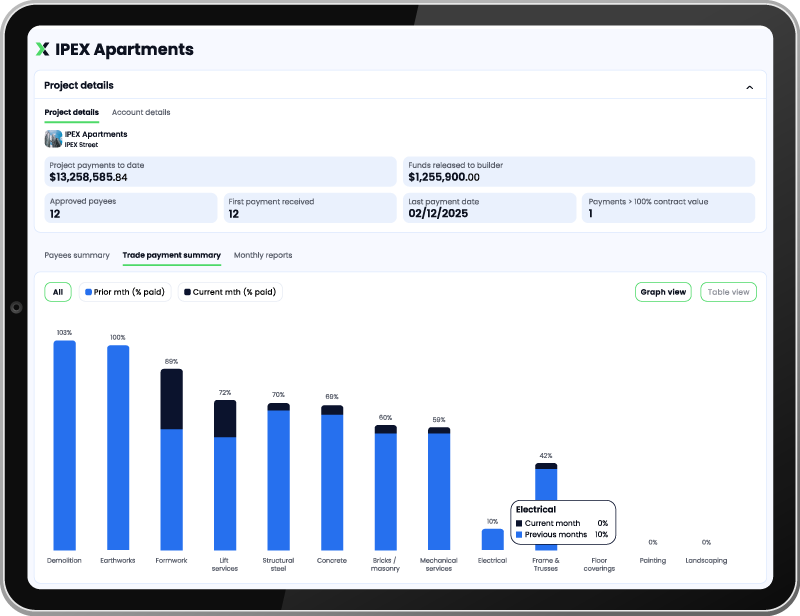
In a functioning project, these figures should broadly correlate. A predictable (but temporary) gap attributable to the operational lag between progress, certification, funding and subcontractor payment is normal.
But it’s when a material gap between progress and payment persists into the next payment cycle (i.e. a new claim has already been submitted) that risk begins to rise.
It’s not about replacing Cost to Complete
Cost to Complete reporting remains essential. It’s just missing is a simple verification step.
IPEX enables developers and lenders to link payment to progress by providing real-time visibility over who has been paid (and who has not), preventing liabilities from quietly accumulating.
The platform allows developers and lenders to:
validate Cost to Complete forecasts against actual cash outflow
identify unpaid subcontractors and suppliers early
resolve payment issues before further claims are approved
detect funding gaps before they become defaults.
IPEX doesn’t change the existing Cost to Complete model—it makes it substantially more reliable.
Builder concerns a thing of the past
Payment transparency does not require builder restrictions or disclosure of confidential information.
While the subcontractor payment ‘blind spot’ is universally acknowledged, a blanket requirement for transparency has often stalled on one argument: some builders won’t accept it.
That position was somewhat understandable when payment visibility meant exposing elements of commercially sensitive information, but that trade-off is no longer necessary.
Subcontractor payment transparency does not require restricting a builder’s access to project funds, nor does it require the builder to disclose subcontract values, payment amounts or margin and letting gains.
Payment validation has become a low-friction control over capital deployment and is now practical at scale because it can be implemented without commercial intrusion.
Unpaid subs builders’ problem—until it’s not
Without validation of both progress and payment, liquidity risk remains hidden, until it becomes loss.
Whether your builder asks for more money, walks from the project or collapses, the gap between Cost to Complete and Cash to Complete will eventually surface—ultimately to be funded by the developer and the lender.
Cost to Complete was never intended to confirm cash distribution. Relying on it as the sole basis for approving drawdowns and releasing project capital represents an avoidable risk and is becoming increasingly difficult to justify, particularly when payments can now be verified via a simple monthly check.
The risk is real. The solution exists. Why would any developer or lender choose to stay in the dark?
The Urban Developer is proud to partner with IPEX to deliver this article to you. In doing so, we can continue to publish our daily news, information, insights and opinion to you, our valued readers.

It’ll Take Gymnastics to Deliver in this Market, Sydney Warned

From Ocean Waste to Housing Fix: Hyperion’s 3D Printing Pivot

Contractor Payment Changes Have Victorian Developers on Back Foot

Glenn Piper’s $60m Hook Island Reboot Leads Whitsunday Awakening


