

Perth’s ‘Unsustainable’ House Prices Defy National Slowdown

Two major markets are facing a subtle downturn in house values, but one countercyclical market continues to experience “unsustainable” growth.
According to Cotality’s latest national home value index, values rose 0.7 per cent in March—up slightly from 0.6 per cent in February—taking home values 2.1 per cent higher for the first quarter of the year.
Cotality emphasised that the pace of gains was easing, down from a 2.8 per cent increase the previous quarter.
The picture was mixed across the country, with Sydney and Melbourne experiencing a “subtle decline trend”.
Mixed bag for the capitals
Since the end of November 2025, Melbourne values decreased by 0.9 per cent, and by 0.4 per cent in Sydney.
Vitality research director Tim Lawless said the softer trend in values coincided with falling auction clearance rates and a pickup in supply.
“[This provides] buyers with more choice and less urgency at the negotiation table,” Lawless said.
Cotality’s Index Results: March 2026
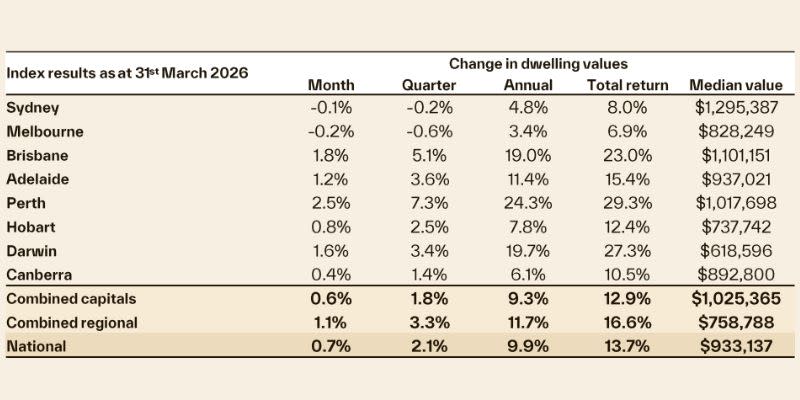
Meanwhile, Perth had the opposite as house values across the Western Australia capital rose 2.5 per cent in March for an increase of 7.3 per cent for the quarter.
“[This rise] has added approximately $69,000 to the median home value,” Lawless said.
“Clearly, this pace of growth is unsustainable, but continues to be supported by low supply, with advertised stock levels tracking about 40 per cent below the five-year average for this time of the year.”
While not quite as strong as Perth, Brisbane remained elevated at a 1.8 per cent increase in home values over the quarter.
Perth, Brisbane and Adelaide are charging ahead at annual rates of growth between 15 and 35 per cent.
Rental markets
Monthly rental growth has stayed steady, increasing at 0.7 per cent over the past three months, taking quarterly rental changes to 2.1 per cent, the biggest increase since May 2024, Cotality said.
The national rental index is up 5.7 per cent, the largest annual change since October 2024, adding $37 per week to the median rental rate.
Nationally, the rental vacancy rate nudged higher in March, reaching 1.6 per cent. But this is still well below the decade average of 2.5 per cent.
Adelaide is the tightest market nationally, at just 0.9 per cent vacancy, followed by Perth at 1.1 per cent, with Sydney the highest at 1.7 per cent.
Calm before the storm
Oliver Hume Property Group chief economist Matt Bell said that the results were probably a little stronger than expected, given the market uncertainty after the Iran conflict.
“Of most interest for land markets is the divergence between higher and lower value suburbs,” Bell said.
“Lower priced suburbs in Sydney and Melbourne, and all other major capitals, are still seeing price growth, dragged down by middle and upper-priced suburbs.”

But he warned that the risks to the 2026 residential market outlook from global instability are “very real”.
“We are already hearing of builders having to eat into margins to cover increased transport and material costs before increasing prices. It won’t last for long,” Bell said.
“Between increased construction costs and broader inflationary impacts requiring rate hikes, the land and established markets are finely balanced, and any significant development in the crisis overseas will have major impacts on how long away any ongoing market recovery is, particularly in Sydney and Melbourne.”


